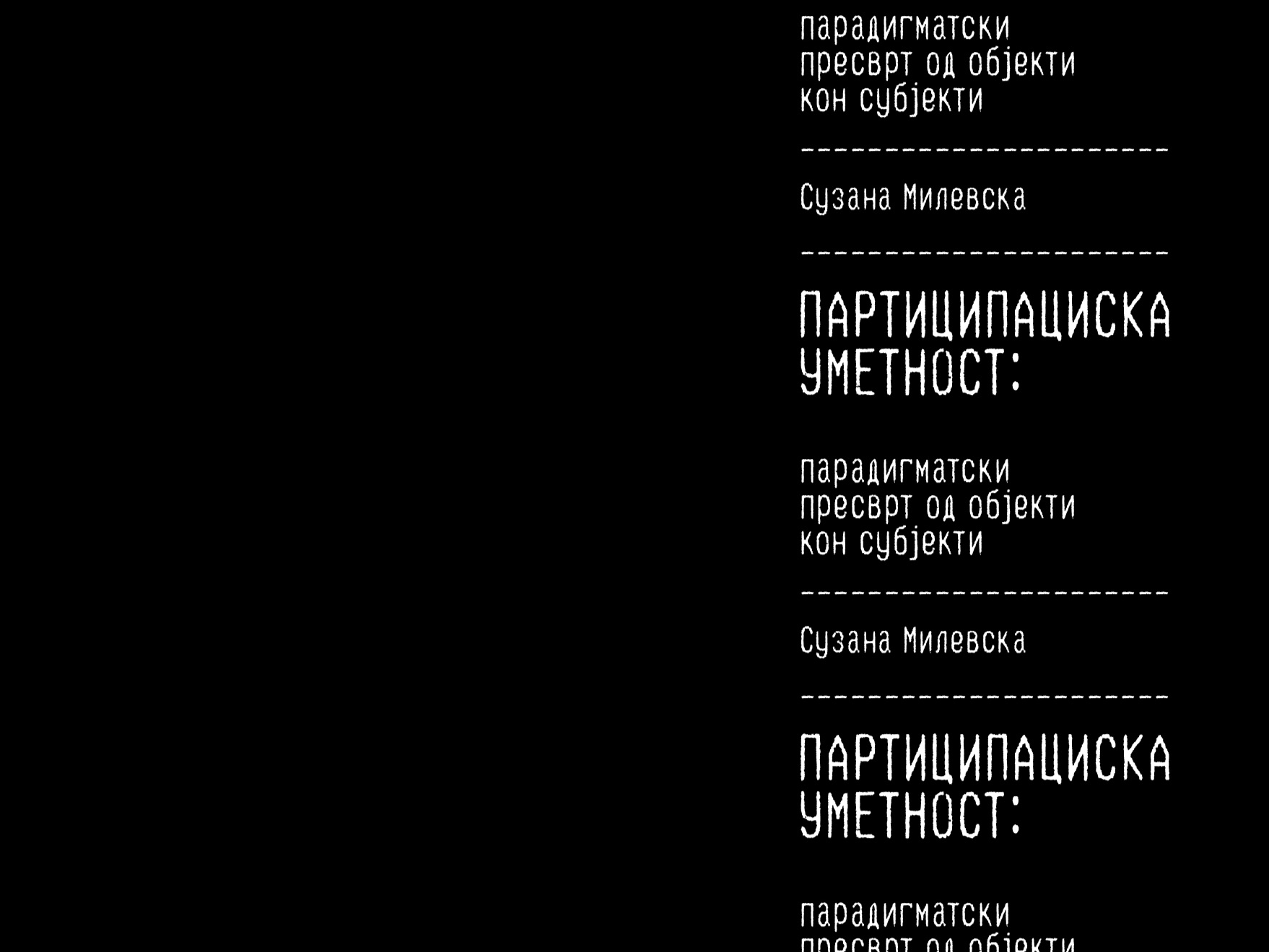
Promotion of a book by Susana Milevska – Participatory Art: A Paradigm Shift from Objects to Subjects
7 Мay (Tuesday) | 19:30 h
SCS Centar – JADRO and Kontrapunkt within the ninth edition of CRIC- a festival for critical culture, a platform that was launched in 2016, are pleased to invite you to the launch of the Macedonian edition of the book “Participatory Art: A Paradigm Shift from Objects to Subjects” by Susana Milevska, one of our most significant theorists of visual art culture and curator.
The promotion will take place in a dialogue format between Susana Milevska and Artan Sadiku, a political philosopher. Iskra Geshoska, cultural theorist and cultural worker, will give introductory words, and Tijana Ana Spasovska, art historian, will make her interventions. The promotion is conceived as an open discursive and participatory event that will include a question and answer session from the attendees.
Participatory Art: A Paradigm Shift from Objects to Subjects gathers a selection of fifteen essays about participatory art with a focus on art and artists in South-Eastern and Central Europe. Milevska wrote and published these texts in English in different publications over a period of more than fifteen years. For the first time, the essays are published together in this collection starting with the first essay written on this topic back in 2006. All essays were translated into Macedonian and edited by Ana Dimishkovska, Dean of the Institute of Philosophy and professor of logic and philosophy, Ss. Cyril and Methodius University, Skopje.
Susana Milevska articulates and interprets the plural, open, changing forms in art which, however, represent a coherent unity, a structure that emphasizes and represents a certain world of relations between individual social and human and intimate narratives, between the political and the artistic. Why is the book of theoretical articulations and reflections of Suzana Milevska of exceptional importance – because of her important intervention in the ethical-political organization of thinking about participatory art, and because of her brave and challenging opening/posing of questions through the possible answers of which the lost can be won again political and artistic space, shattered by the merciless attacks of global neoliberalism. Milevska, apart from offering a wide range of advantages and pitfalls that participatory art brings with it in a multi-year epistemological perspective, she simultaneously introduces us to a different perspective through which we perceive institutional labyrinths and post-colonial spirals, and all of that, of course , with extremely careful insistence on the contexts in which such dynamics take place.
Kontrapunkt also published Milevska’s book in English, and the promotion of the English edition was in March 2024, in New York.
Suzana Milevska is a theorist and curator of visual art and culture. Her theoretical and curatorial interests include postcolonial critique of hegemonic power regimes of representation, gender difference in visual culture, and feminist, participatory, and collaborative art practices. Milevska was a Principal Investigator of the Horizon 2020 project TRACES, at Polytechnic University Milan, and in 2019 she curated its concluding exhibition Contentious Objects/Ashamed Subjects. In 2013 she was appointed an Endowed Professor for Central and South Eastern European Art Histories at the Academy of Fine Art Vienna(2013 – 2015). Milevska holds a Ph.D. in visual cultures from Goldsmiths College University of London. In 2004 she was a Fulbright Senior Research Scholar at Library of Congress inWashington D.C. She curated numerous international exhibitions and initiated the project Call the Witness–Roma Pavilion, Venice Biennale (2010-2011). Her texts have been translated into Bulgarian, Croatian, English, French, Hungarian, German, Italian, Japanese,Russian, Serbian, Slovenian, Spanish, Swedish, Turkish, etc. Her authored and edited books amongst others include Gender Difference in the Balkans, 2010, The Renaming Machine: The Book, 2010, and On Productive Shame, Reconciliation, and Agency,Sternberg Press, 2016. In 2012 she won the Igor Zabel Award for Culture and Theory.
This book is published within the project Peripheral Visions – towards a trans(l)national publishing culture, which strives to develop international exchange between small cultural and linguistic contexts in the Euro Semi-peripheries, supporting each other through co-production, co-creation, knowledge transfer and resource sharing. Through multilingual publishing, transdisciplinary cultural production, alternative distribution, exchange of knowledge, digital content, open-source digital technologies, and new game formats, the project creates an international space for creation and experimentation in the publishing process. Peripheral Visions is a joint project of Kulturtreger, Maska Ljubljana, eipcp –European Institute for Progressive Cultural Policies, kuda.org, Kontrapunkt and MultimediaInstitute, and associated partners Kulturföreningen Glänta and EUROZINE.
The publication is financially supported by the Ministry of Culture of the Republic of North Macedonia and the Creative Europe Program of the European Commission. Funded by the European Union. Views and opinions expressed are however those of the author(s) only and do not necessarily reflect those of the European Union or European Education and Culture Executive Agency (EACEA). Neither the European Union nor the granting authority can beheld responsible for them.
Additional Details
Project Title -
Project -