Book Promotion: Gabresh and the People of Gabresh
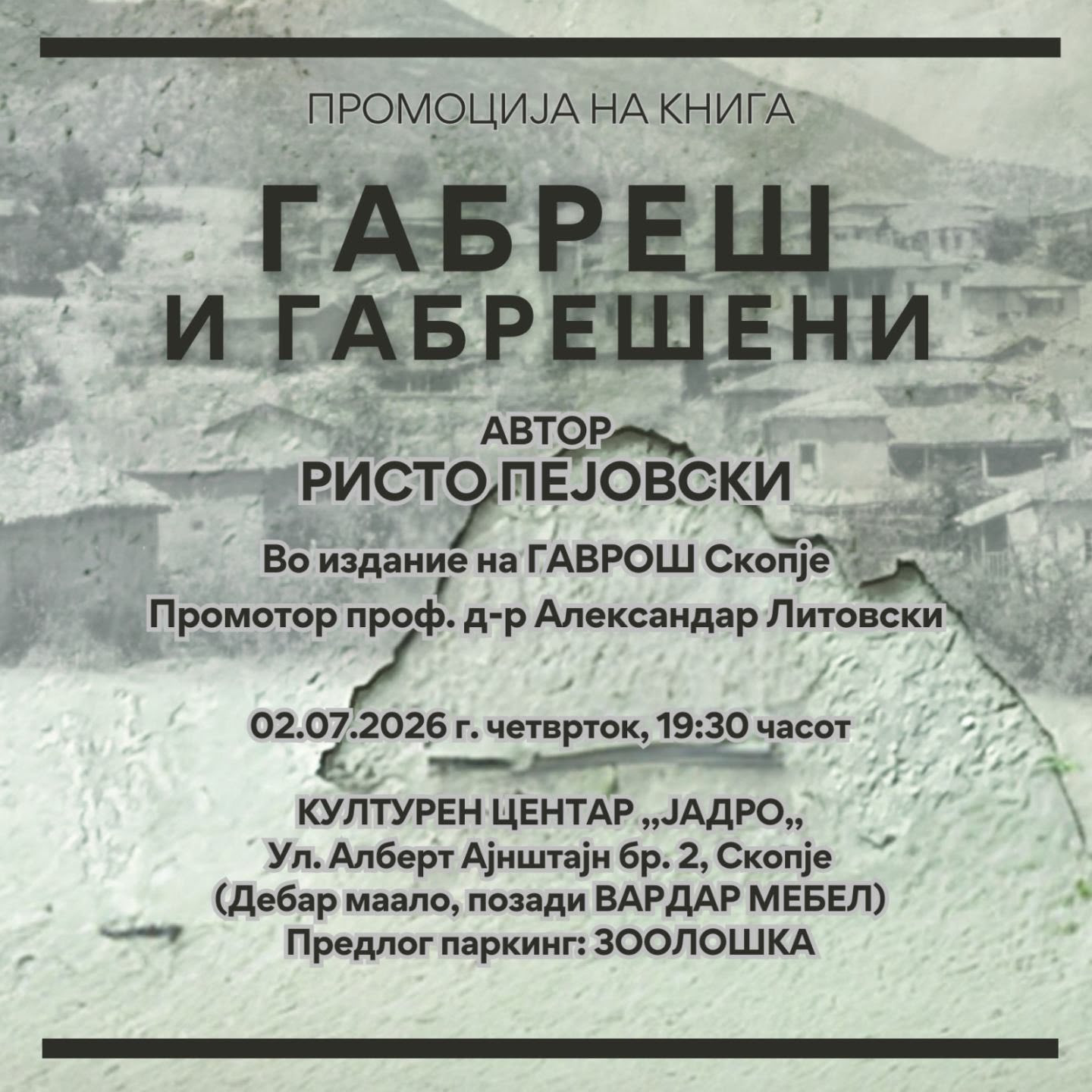
On 2 July (Thursday) at 19.00, Cultural and Social Space SCS Centar-Jadro will host the promotion of the book Gabresh and the People of Gabresh by Risto Pejovski.
The book is a monograph dedicated to Pejovski’s birthplace, the village of Gabresh in the Kostur (Kastoria) region of Greece. Following the Greek Civil War (1946–1949), the village was devastated, leaving only 46 families and a total of 132 inhabitants. Today, its population has been entirely relocated to the newly established village of Korestia (Neos Ikismos). Although the manuscript was completed in 2004, it is being published posthumously by Gavrosh Publishing House with the support of the Pejovski family. The book will be presented by Prof. Dr. Aleksandar Litovski.
Gabresh and the People of Gabresh offers a vivid and richly detailed account of the village’s history, from its founding several centuries ago to its present-day condition. Focusing primarily on the 1920s and 1930s while covering a broader historical period, the book paints a comprehensive ethnographic portrait of the village’s architecture, local governance, agricultural production, trade, and culinary traditions.
Through extensive descriptions of wedding customs, folk songs, children’s games, clothing and its evolution, traditional healing practices, and seasonal agricultural work, readers are immersed in the everyday life of the people of Gabresh and the rhythms that shaped their community throughout the year.
The book also serves as an important historical source on the emergence and activities of IMRO (VMRO) among the villagers, the period of the Metaxas dictatorship (1936–1941), the anti-fascist resistance (1941–1945), the SNOF Conference for the Kostur region, the Greek Civil War, and the activities of the Democratic Army of Greece (DAG). It includes biographical information about numerous families from Gabresh, tracing their lives as child refugees, intellectuals, merchants, emigrants, and later residents of the Socialist Republic of Macedonia and the Republic of Macedonia. The publication also contains explanations of the dialect vocabulary characteristic of the Kostur-Korça linguistic area.
Risto Pejovski was born in 1921 in the village of Gabresh, Kostur region, Greece. After completing primary school, he attended high school in Kostur and later the American Farm School in Thessaloniki. In November 1942, he continued his education at the Gymnasium in Bitola. Following the occupation of Greece, he joined the anti-fascist resistance, for which he was arrested and imprisoned for six months. In April 1942, he began collaborating with the partisan unit led by his brother Naum Pejovski and operated underground. As the activities of the “Lazo Trpovski” partisan detachment intensified, he was elected secretary of its youth organization, consisting of around sixty young women and men. In November 1944, he became youth leader of the Fourth Battalion of the Macedonian Strike Brigade.
After the war, Pejovski worked in the state security services and, from 1955, in the Secretariat of Internal Affairs. That same year, he enrolled at the Faculty of Law in Skopje and, after graduating, became an instructor at the Training Centre for Internal Affairs personnel. He also served as a member of the Municipal Assembly of Kisela Voda and the City Assembly of Skopje. In 1971, he was a delegate to the Second Congress of Yugoslav Self-Managers in Sarajevo, where he delivered one of the most outspoken critical speeches addressing the social and political challenges facing Yugoslavia.
For his professional and public service, he received numerous high state decorations in former Yugoslavia, including the Order of Merit for the People with Golden Wreath. He was married to Kornelija Pejovska (née Mrakova), herself a participant in the Democratic Army of Greece, as well as a poet and writer. Together they had two daughters, Liljana and Sofka, and a son, Zlatko.
Risto Pejovski passed away in Skopje on 24 November 2006, at the age of 85.
Additional Details
Project Title -
Project -